Wednesday 13 May 2026, Flutter immersive zone, Leeds
Last week in a live demo, Enablis CTO Ed Marshall sent an email to a team of six AI agents.
Eleven minutes later, the bug he described had been triaged, fixed, tested, reviewed, deployed and the customer was getting a personal reply.
Six agents. Roughly 140 tool calls. Total compute cost: A few dollars.
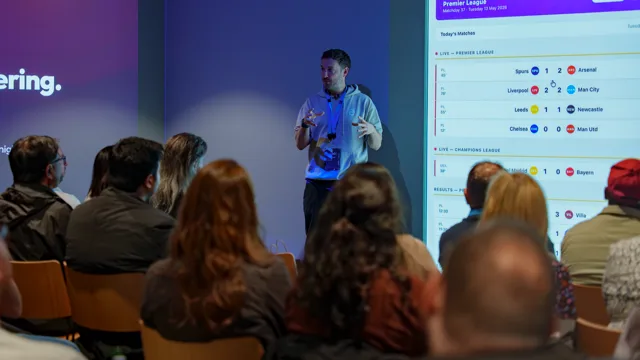
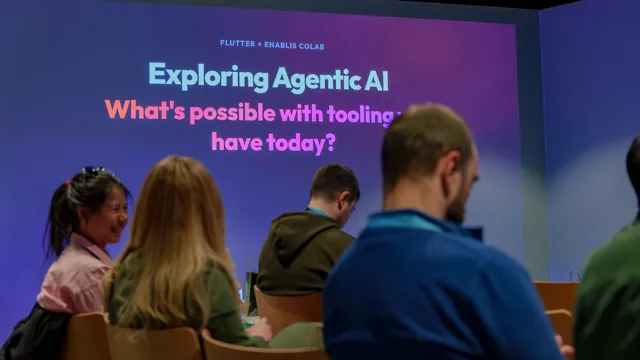
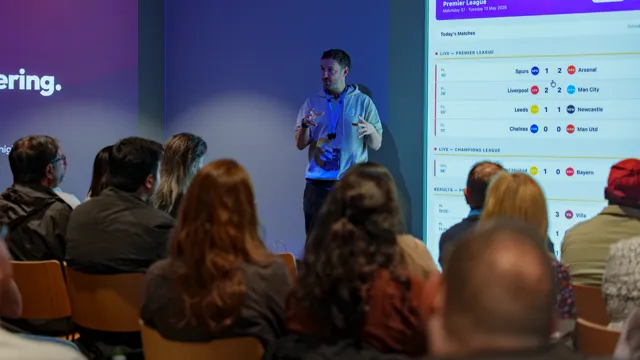
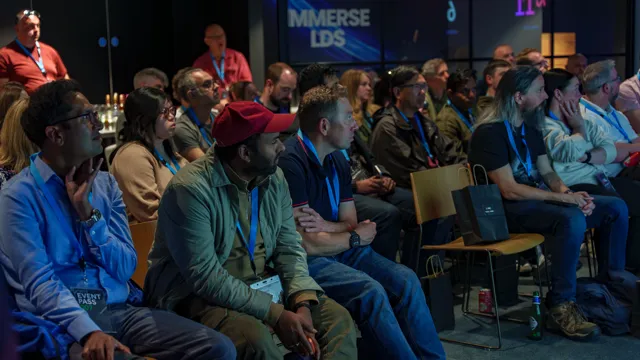
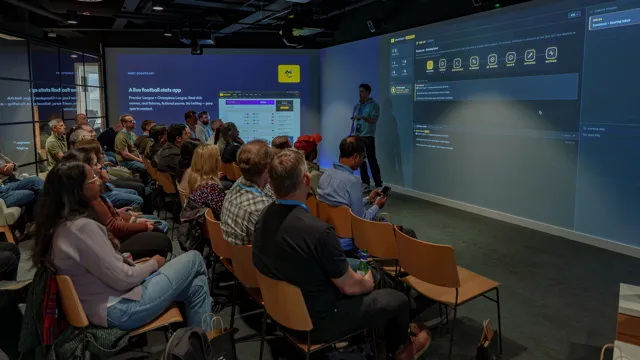
No rehearsal, no pre-recorded footage, just fifty senior techies in the room and three giant screens wrapping the audience inside Flutter’s immersive zone, one of the most distinctive event spaces in Leeds.
This was the second event in our colab series and our first hands-on, made possible by Flutter. The first was an exclusive roundtable dinner - senior tech leaders working through the AI questions that don’t get asked in public. Our live demo was built to answer one question: what does agentic AI actually look like when it’s running inside real software, not just eluded to on a slide?
Flutter were the right team to do that with. As a business operating at scale and deeply rooted in Leeds’ business community, they’ve invested heavily in responsible AI which shaped the type of conversation we wanted to have in the room – how AI gets built, governed and utilised within enterprise.
What happened on the night
A complaint email landed in an inbox claiming ScoutCast (a live football stats app built by Enablis for the demo) - was showing a full-time score despite still being mid-game.
Ed forwarded it to the team. The team was six AI agents: a Product Agent, a Developer Agent, a QA Agent, a Reviewer Agent, a Release Agent and a Customer Support Agent. Each one with a defined role, scoped access, and authority over a different slice of the delivery pipeline.
From there, the room watched the full loop unfold on screen. Triage in Linear. Fix in GitHub. Tests in Actions. Review by a second agent. Deploy via Terraform. A personal reply back to the customer. End to end. Nobody touched a keyboard.
Three things stood out.
1. 11 minutes from inbox to live fix
Most engineers know what the same bug looks like in their day-to-day. A ticket gets raised. It sits in a backlog. Someone picks it up, asks for clarification, writes the fix, opens a PR, waits for review, waits for CI, gets a comment, fixes the comment, gets reviewed again, merges, monitors the deploy. Then someone in support replies to the original customer - usually a couple of days later. Realistic end-to-end timeline: 3-5 days.
On the evening, it was eleven minutes. From a single email.
Reframe that as an engineer. You spot a bug at the train station on the way to work. You email it to your agent team. By the time you’ve reached your desk and made a coffee, it’s fixed, deployed, and the customer who reported it has had a reply.
That isn’t a productivity gain. It’s a different shape of work. The question for engineering leaders is what your team does with the hours they get back - when the inbox-to-fix loop stops being a multi-day project.
2. A few dollars in credits versus thousands in staffing
When the demo ended, Ed put the cost up on screen. The compute bill for the full run - six agents, ~140 tool calls, end-to-end loop - came in at a few dollars.
The traditional staffing cost to do the same job - engineering time to triage, reproduce, fix, test, review, deploy and reply – could run into the thousands of pounds.
That figure stops most AI cost conversations in their tracks. Because the conversation in most boardrooms right now is “what are we spending on AI tooling?” The credits look expensive until you set them against the work they’re replacing.
The real cost question for AI isn’t the cost to implement. It’s the cost to deploy new tools and fix the features you’ve already built. That number has been invisible for years because it’s spread across engineering payroll. Agentic AI makes it explicit. Once it’s explicit, under-investing in tooling stops being the cautious choice. It becomes the expensive one.
3. Every safeguard the human team had, the agents had too
The most useful slide of the night was the one that listed what didn’t change.
- Branch protection
- Code review
- Regression tests
- Deploy gates
- Audit trail
- Rollback capability
Every control a human team would have on a fix going to production was still in place. The Developer Agent couldn’t deploy. The Release Agent couldn’t merge. The QA and Reviewer Agents had to give independent sign-offs - the demo deliberately showed a moment where the two disagreed and the Developer had to revise. Least-privilege access wasn’t a slide; it was the architecture.
Ed said: “The agents are inside Enablis’s delivery practice, not around it. That’s the bit that travels into regulated environments. The agents move faster than humans, but the rails they run on are the same.”
For engineering leaders in regulated industries, that’s the answer to the “yes but how do I trust it?” question. You don’t trust the agent. You trust the same governance you were already running. The agent just operates inside it.
What it means
The line Ed closed on, and the one we’ve been making to clients for months, is this:
“We didn’t speed up engineering. We removed waiting.”
Ed Marshall, CTO, Enablis
Humans wait for each other. For triage to finish. For review overnight. For the next deploy window. The work itself is mostly fast. The waiting is where the days go.
Agents wake on events, not calendars. When triage finishes, development starts. When the PR lands, review starts. When review finishes, deploy starts. The 11-minute loop wasn’t faster engineering. It was the same engineering, minus the gaps between the steps.
That reframe is the heart of why we wrote our new whitepaper, AI Unfiltered – coming soon. AI doesn’t deliver value when it sits next to delivery. It only delivers value when it’s embedded in it - with the same safeguards, the same governance, and the same accountability the human team already had.
A huge thank you to Adam Wilbraham and the wider Flutter team. Being our first colab partner mean trusting the format, opening up one of Leeds’ best venues, and being properly part of the conversation throughout.
Flutter’s investment in responsible AI and the seriousness with which they’ve embedded it into how the business actually runs is exactly why this partnership has worked and why we’d recommend any tech team in the city keep a close eye on what they’re achieving.
Thanks too to everyone who stayed well past the pizza.
Want to be in the room next time?
Colab is a community-driven AI event series from Enablis, built around a simple belief: the best AI conversations happen when the right people are in the right room.
Each edition runs as two connected events with a single co-host partner. First, a roundtable dinner for senior leaders - CTOs, CIOs, Heads of Engineering - to have the honest, strategic conversation that rarely happens on a conference stage.
Then a hands-on session for the engineers, product managers and tech leads responsible for making it real. Same theme. Two audiences. One complete picture.
The next edition is in planning! If you’d like to be on the list as an attendee or as a partner, please get in touch: colab@enablis.co