

Financial services organisations are being asked for changes and technology delivery at a pace that would have felt unrealistic a decade ago.
- Digital channels are now the primary customer touchpoint.
- Regulatory requirements continue to evolve.
- Competitive pressure is constant.
At the same time, expectations around stability, security and operational resilience have only increased.
This tension often exposes a deeper issue. Many delivery models still prioritise control over outcomes. Manual approvals, siloed teams and layered governance processes create the appearance of safety but can introduce delay, ambiguity and hidden operational risk.
Drawing on our experience working alongside technology and delivery teams across the financial services industry, here are five practical insights that consistently make a difference.
1. Speed and safety are not trade-offs
A common assumption is that moving faster inevitably increases risk. In practice, the opposite is often true.
When change is infrequent, heavily gated and reliant on manual review, issues are harder to detect and remediate. Large releases accumulate risk. Knowledge becomes fragmented across teams.
By contrast, smaller and more frequent changes supported by automated testing, embedded security controls and real-time observability can reduce risk exposure. Auditability improves because controls are codified and consistently applied. Issues surface earlier in the lifecycle when they are cheaper and easier to fix.
Acceleration done well strengthens control rather than weakening it.
2. Ownership drives accountability and better outcomes
Clear service ownership is one of the most powerful levers for improving delivery.
In traditional models, delivery and service teams can operate with different incentives. Service teams are understandably focused on platform stability and risk avoidance. Delivery teams are focused on feature evolution and change.
Modern ownership models, including variations of “you build it, you run it”, align those incentives. When teams are accountable for both feature delivery and ongoing service performance, trade-offs become more explicit. Design decisions consider operational impact from day one.
Ownership models do not need to be adopted dogmatically. In regulated environments, pragmatic adaptations often work best. The principle is clarity of accountability, not strict adherence to a methodology.
3. Automation is more reliable than manual governance
Many governance processes in financial services were designed in an era of infrequent releases and static infrastructure. Change Advisory Boards, periodic approval forums and manual evidence collection made sense in that context.
However, when delivery frequency increases, manual governance becomes a bottleneck.
High-performing teams shift risk management earlier in the lifecycle and embed controls into automated pipelines. Infrastructure is defined as code. Security checks run automatically on every change. Deployment processes are standardised and repeatable across environments.
Rather than reviewing change after it is prepared, governance becomes continuous and real-time. This reduces friction while increasing consistency and traceability.
4. Modernisation is as much organisational as it is technical
Technology change alone is rarely sufficient.
Legacy platforms, third-party dependencies and regulatory constraints are real challenges. But organisational structures, process design and cultural norms often present the greater barrier to progress.
Successful programmes treat modernisation as both a technical and organisational evolution. Supporting functions such as security, change management and service operations are engaged early and become active participants in shaping new ways of working.
When those teams see that faster delivery can reduce reactive workload and improve visibility, they often become advocates rather than gatekeepers.
5. Start with a platform, not a transformation
Large-scale transformation initiatives can feel abstract and risky.
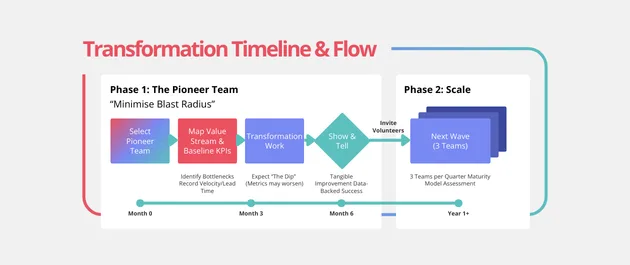
A more practical approach is to identify a specific platform, product, or capability that can act as a spearhead for change. Use it to prove new engineering practices, refine governance models and demonstrate measurable outcomes.
Metrics such as deployment frequency, lead time for change, incident rates and time spent on reactive support provide objective evidence of progress. Over time, these patterns can be extended across the organisation with greater confidence.
Explore further
These insights are explored in more detail in our whitepaper:
Accelerating Technology Delivery in Financial Services Without Increasing Risk